
Once-Fired Brass vs. New Brass: What’s Better for Reloading?
Jeremy Walberg Jun 25, 2026
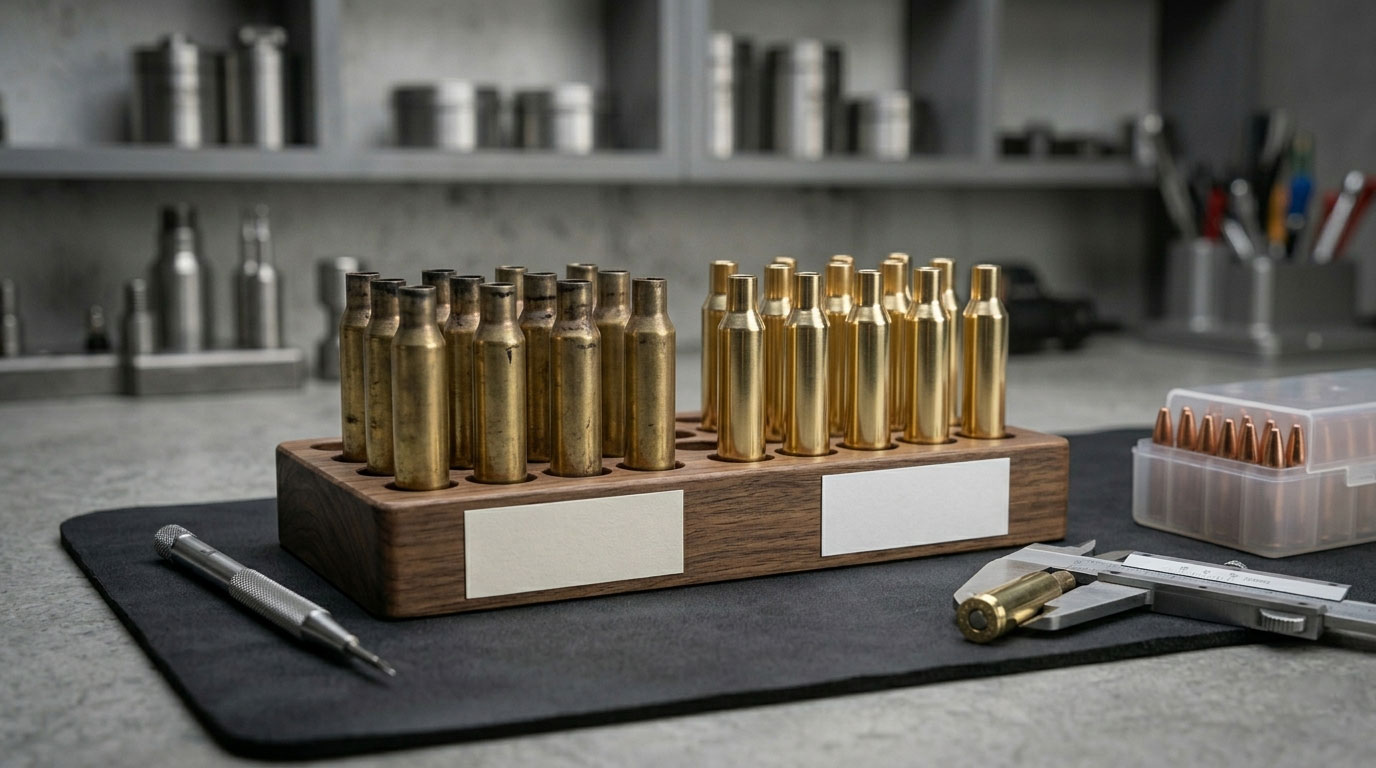
Once-Fired Brass vs. New Brass: What’s Better for Reloading?
Meta description: New brass costs more and ships uniform. Once-fired is cheaper but needs prep. Here’s how to decide which fits your reloading goals.
For most reloaders, the answer is “both, depending on the rifle and the application.” New brass — especially premium brass like Lapua or Norma — gives you the most consistent starting point and is worth the cost for precision rifles, load development, and competition use. Once-fired brass is typically half the price or less, performs well after proper prep, and is the right choice for high-volume practice ammo and informal shooting.
What you’re actually paying for with new brass
Premium new brass (Lapua, Norma, Peterson, ADG) ships with consistent neck wall thickness, uniform case capacity, and tight overall length tolerances. For a precision rifle, that consistency translates directly to lower velocity standard deviation and tighter groups at distance. It’s also annealed correctly out of the box, so neck tension is uniform across a fresh lot.
Mid-grade new brass (Hornady, Winchester, Federal, Starline) is meaningfully better than range-pickup once-fired but doesn’t reach Lapua-level consistency. For most precision applications, it’s a reasonable middle ground.
Pricing as of 2026 runs roughly:
- Lapua/Norma .308 or 6.5 Creedmoor: $1.20–$1.80/case for new
- Hornady or Winchester: $0.70–$1.20/case for new
- Once-fired Lake City or commercial: $0.30–$0.60/case
- Once-fired premium (Lapua headstamp, range pickup): $0.50–$1.00/case if you can find it
Once-fired brass: what you’re actually buying
“Once-fired” means the case has been fired one time and not yet reloaded. The quality varies enormously depending on:
- Source — military Lake City and commercial range pickup are both common but very different
- Headstamp uniformity — sorted by headstamp lots is worth more than mixed
- Inspection history — was it visually inspected for cracks? Was the primer pocket gauged?
- What it was fired in — a chamber that was loose, hot, or out-of-spec leaves brass that’s been worked harder
Reputable sellers separate brass by headstamp, inspect for cracks, and clean the cases. Fly-by-night sellers don’t.
What once-fired brass needs before reloading
Once-fired brass is not ready to reload out of the bag. Standard prep:
- Visual inspection — check for case-head separation, neck cracks, deep dents, primer pocket damage
- Decapping — remove the spent primer
- Cleaning — wet tumble with stainless pins, dry tumble with corncob, or ultrasonic
- Full-length resize — restores the case to factory dimensions; bumps the shoulder back so it’ll chamber
- Trim to length — cases stretch on firing; trim back to spec
- Chamfer and deburr — clean up the case mouth so the bullet seats straight
- Primer pocket uniform — clean and uniform the primer pocket so primers seat to consistent depth
- Flash hole deburr — once, on first firing of a new case, removes the punch burr
- Anneal (optional but recommended for precision work) — restores neck softness for consistent neck tension
Plan on 30 to 60 minutes of prep per 100 cases, more for the first pass on a new lot. After that initial prep, subsequent loadings are faster.
Brass life
Both new and once-fired brass have finite reloading life. Indicators that a case is at the end:
- Case-head separation marks — visible bright ring near the case head, or a feel of thinning when you run a paperclip inside
- Loose primer pockets — primer falls out easily or doesn’t seat with consistent resistance
- Neck cracks — usually shows up first on annealed cases that have gone too many cycles without re-annealing
- Repeated stuck cases in extraction
Premium brass annealed every 3–5 firings can last 8–12 firings in a precision rifle. Range pickup brass might give you 3–5 firings before showing wear. Hot-loaded magnum brass (heavy charges, full-length sized aggressively) lasts noticeably less.
Which to use for what
Use new premium brass when:
- You’re load-developing a precision rifle and want a uniform baseline
- You’re building competition ammunition where every fps of velocity SD matters
- You’re hunting and want maximum reliability on the cold shot
- You’re shooting magnums or wildcats where brass behavior is poorly characterized
Use once-fired brass when:
- You’re shooting volume — practice, training, plinking, three-gun
- You’re reloading a common cartridge (.223, .308, 5.56, 9mm) where prep is well-understood
- Cost-per-round matters more than the last percent of consistency
Many serious reloaders run two parallel batches: precision new brass for match and zero work, prepped once-fired for volume practice.
What separates good reloads from bad
The brass is one variable. Equally important:
- Consistent powder charges — a quality powder thrower or trickler, weighed to ±0.1 grain for precision work
- Consistent bullet seating — repeatable depth measured from the ogive
- Quality primers — match-grade primers (CCI BR2, Federal 210M, Wolf Match) for precision loads
- Velocity testing — a chronograph reveals what your loads are actually doing, regardless of brass source
Good reloading practice with either brass type beats sloppy practice with the best brass on the market.
Match the brass to the rifle’s purpose
A precision rifle deserves precision components, including the brass. A practice rifle running 800 rounds a month doesn’t. The right call is application-specific, and most serious reloaders end up running both — which is the practical answer to the original question.
Related services
- Custom rifle chambering — a precision chamber pairs naturally with quality brass and tuned loads
- Receiver blueprinting — improves the accuracy ceiling that quality reloads can deliver

Information