Why Cerakote Is a Top Finish for Firearms and Parts?
Jeremy Walberg Jun 25, 2026
Why Cerakote Is a Top Finish for Firearms and Parts?
Cerakote is the dominant aftermarket firearm finish in the U.S. custom shop world, and it earned that position by outperforming bluing on corrosion resistance, parkerizing on durability, and most factory finishes on chemical resistance - while being available in any color combination a coater can mix. It's not magic, and it's not perfect for every application, but for most modern firearms in most environments, it's a top finish for good reasons.
What Cerakote actually is
Cerakote is a thin-film polymer-ceramic coating sprayed onto firearm parts and oven-cured at around 250°F. The H-Series (oven-cured) is the industry standard for firearms; C-Series air-cure exists for parts that can't be baked. After curing, the finish is typically 0.001"-0.0015" thick, hard, abrasion-resistant, and chemically inert.
The coating bonds to the substrate through a combination of mechanical adhesion (the polymer keys into the surface profile created by media-blasting) and a small amount of chemical adhesion. Marketing claims about ";molecular-level bonding" overstate the chemistry - what actually happens is well-understood thin-film adhesion, and proper surface prep is what makes it work.
How it compares to other firearm finishes
|
Finish |
Corrosion resistance |
Wear resistance |
Customization |
Cost |
|
Bluing |
Poor (needs oil) |
Moderate |
None (black) |
Inexpensive |
|
Parkerizing |
Moderate (oil-impregnated) |
Good |
None (gray/green) |
Moderate |
|
Nitride / Melonite |
Good |
Excellent |
None (black) |
Moderate |
|
DLC |
Excellent |
Excellent |
Limited (black) |
Premium |
|
Cerakote H-Series |
Excellent |
Very good |
Unlimited colors |
Moderate-premium |
|
Anodizing (aluminum) |
Excellent |
Excellent |
Wide color range |
Moderate |
Cerakote isn't the absolute best at any single attribute - DLC edges it on hardness, anodizing on aluminum corrosion - but it's the most versatile across the board. For the typical shooter looking at a steel firearm, Cerakote is the right answer.
Where Cerakote earns its keep
Corrosion resistance. Cerakote H-Series passes ASTM B117 salt spray testing for hundreds of hours without rust. Bluing is essentially useless here without constant oiling. Parkerizing helps but requires oil that has to be reapplied. For a hunting rifle in wet country, a duty pistol on a sweaty hip, or a coastal-environment carry gun, the difference matters.
Abrasion and chemical resistance. Holster wear, bore solvents, CLP, sweat, sunscreen, bug spray - Cerakote shrugs off the chemicals that damage other finishes. Rated to roughly 500°F continuous, well above any normal firearm operating temperature.
Tight tolerances preserved. At 0.001" thick, Cerakote doesn't bind moving parts when applied correctly. Slides cycle, bolts close, threads mate. Compare to spray-on coatings that go on at 0.003"-0.005" - those can interfere with precision components.
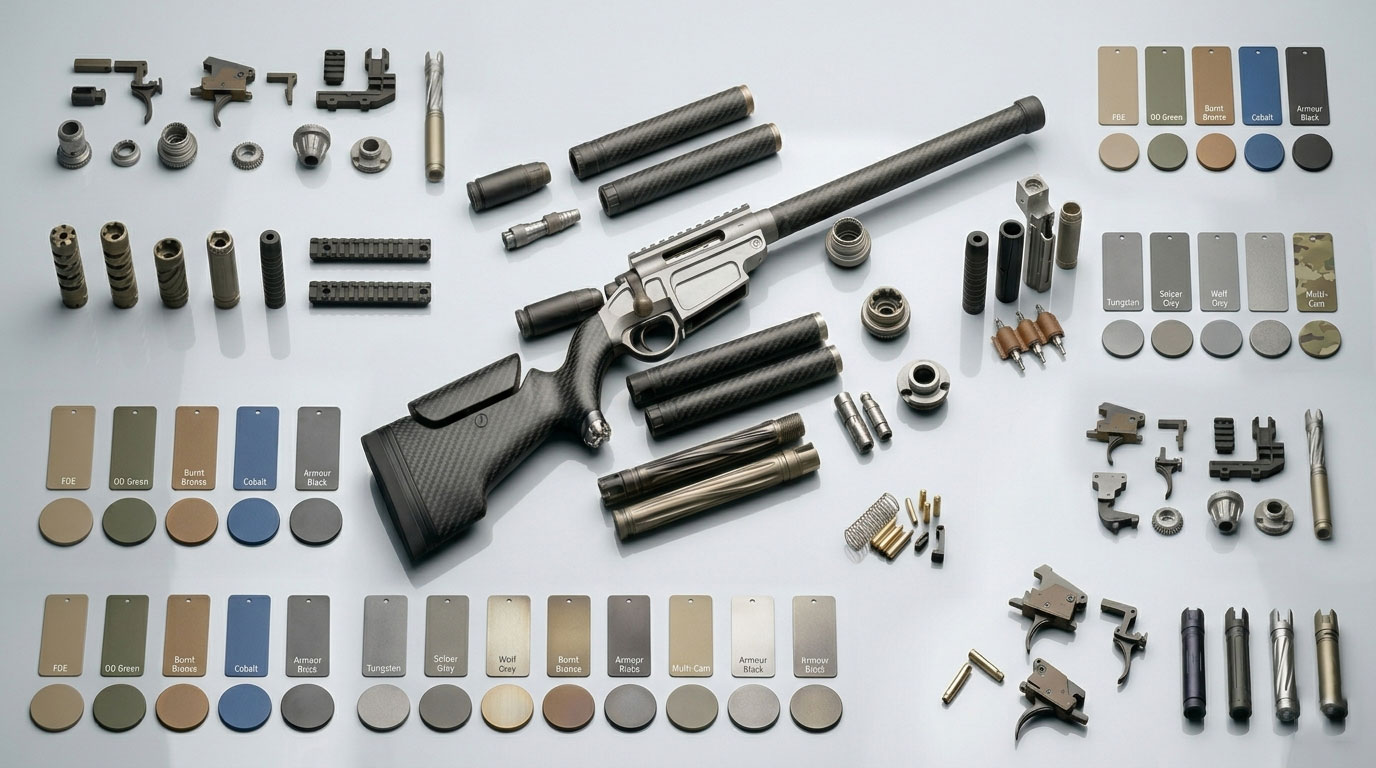
Customization. Over a hundred standard colors plus any custom mix. Patterns - stippled, hydrographic-style camo, multicam, distressed, two-tone with masked lines, engraved fills - are limited only by the coater's skill. Bluing, parkerizing, nitride, and DLC all give you essentially one color (black or near-black). Cerakote gives you anything you can imagine.
What Cerakote doesn't do
It doesn't fill or hide. Surface prep is the foundation. Every dent, scratch, and machine mark transfers through the finish. The coater media-blasts the part to a uniform surface profile before coating, which evens out small surface variations but won't hide actual damage.
It does wear at high-friction points. Slide rails on a working pistol, lug abutments on a bolt action, the holster contact zone on a duty firearm - these are normal wear patterns, not coating failures. A heavily used Cerakoted firearm will show wear in years, not days, but it will show wear.
It needs proper application. The difference between Cerakote that lasts 10+ years and Cerakote that chips off in months is application quality. Surface prep, blast media choice, primer use, coating thickness, and cure schedule all matter. A reputable coater hits the spec; a hobbyist with a $200 spray gun and a kitchen oven won't.
Application and process
A typical Cerakote job:
- Disassembly - the firearm comes apart; coatable parts are separated from polymer, optics, springs, and rubberized components
- Surface prep - degreasing, masking, media-blasting to a 1–2 mil profile
- Pre-bake - drives off moisture from the substrate
- Coating application - spray gun, multiple passes, masking for two-tone or pattern work
- Oven cure - 250°F for 1–2 hours depending on the specific Cerakote color
- Cool and reassemble - usually with replacement of any components that couldn't be recoated
Pricing as of 2026 typically runs:
- Single color, full firearm - $150–$300
- Two-tone or multi-component - $300–$500
- Multi-color pattern (camo, multicam, custom) - $400–$800+
- Premium presentation work - $800+
Turnaround is typically 2–4 weeks at a busy shop, longer at high-end coaters who book months out.
When Cerakote is the right call
Pick Cerakote when:
- You want serious corrosion and wear protection on a steel firearm
- You want a custom color or pattern
- The firearm sees outdoor use, holster carry, or hard environments
- You're building a custom rifle or pistol and want a finish that matches the rest of the work
Skip Cerakote when:
- The firearm is a collector piece where original bluing has historic value
- You need the absolute hardest finish available (specify DLC instead)
- The part is aluminum and you want the lightest, most permanent finish (specify hard anodize instead)
Pairs naturally with custom machining
Cerakote is almost always the last step in a custom build. Threading, slide milling, fluting, engraving - all happen before the part goes to the coater. That sequence ensures any newly machined surfaces get protected before the rifle goes into service.
If the build includes laser engraving, the engraving usually happens after Cerakote - the laser ablates the coating to expose the substrate underneath as the contrasting color.
Talk to your coater early
If you're spec'ing a build, decide on the finish before the parts go to coating. Color matching across components (slide and frame, action and barrel) requires the coater to know what's going where. And if any of the build involves NFA items, refinishing those items has its own paperwork - coordinate with your gunsmith and your Form 4 dealer.
For most modern firearms, Cerakote is the most versatile, durable, and customizable finish available. It's not the only option, and it's not always the right one - but for the typical custom build, the typical hard-use firearm, and the typical buyer who wants their rifle or pistol to look as good as it shoots, it earns its place at the top of the list.
Related services
- Laser engraving - common follow-on to Cerakote for logos, names, and event marks
- Pistol slide milling - usually finished with Cerakote afterward
- Muzzle threading - threaded barrels typically Cerakoted along with the rest of the rifle
Information