
Custom Precision Rifle Building: A Complete Beginner’s Guide
Jeremy Walberg Jun 25, 2026
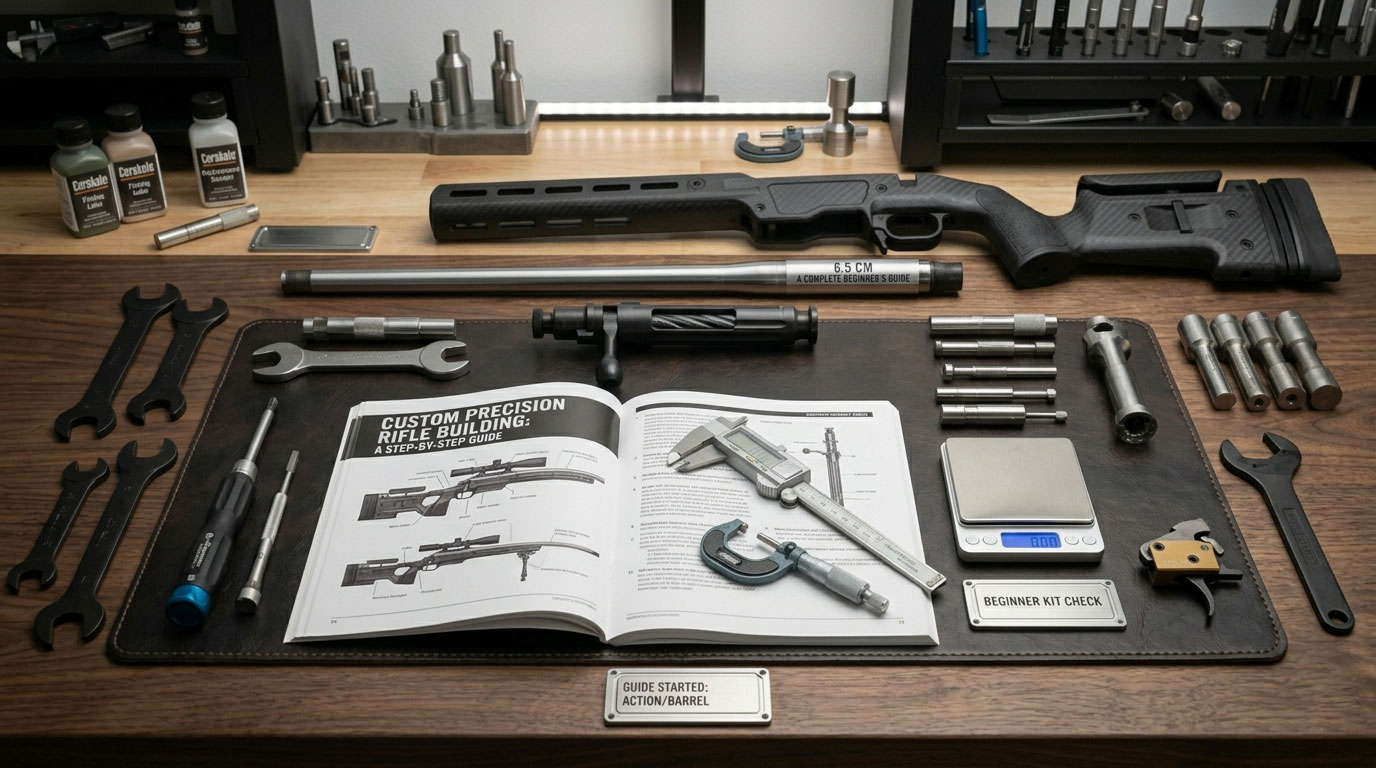
Custom Precision Rifle Building: A Complete Beginner’s Guide
A custom precision rifle is a sum of decisions, not a single product. You pick an action, a barrel, a trigger, a chassis, an optic, and an ammunition spec, and a gunsmith makes them work together at the tolerances that off-the-shelf rifles can’t match. For a first-time custom build, the goal isn’t to spec the most exotic version of every component — it’s to understand which decisions actually drive the rifle’s performance and to invest where it matters.
Start with the action
The action is the foundation. Everything else fits to it.
For a first custom precision build, the most common starting points are:
- Tikka T3x — excellent factory action that benefits from a barrel swap and chassis; pre-fit barrels available
- Remington 700 footprint — vast aftermarket support; clones from Defiance, Bighorn, ARC, Surgeon, and others; standard target for blueprinting
- Custom right-from-the-start — Defiance, ARC Nucleus, Bighorn TL3, Impact 737, Zermatt — actions purpose-built for precision work with truer-from-the-factory tolerances
If you choose a factory Remington 700, plan on receiver blueprinting — truing the action face, lapping the lug abutments, truing the bolt face — to bring it to custom-action tolerances. A pre-trued custom action skips that step.
Pick the barrel
Barrel maker matters more than almost any other component decision. Bartlein, Krieger, Proof, Benchmark, Hawk Hill, Brux, Rock Creek — these are the names that win matches. For a first build, pick one and don’t overthink it.
What you actually have to spec:
- Cartridge — for a versatile precision rig, 6.5 Creedmoor, 6mm Creedmoor, 6.5 PRC, or .308 Winchester are all defensible starting points
- Twist rate — match the cartridge and bullet weight you’ll shoot (1:8 for most modern 6.5 Creedmoor loads, 1:7.5 or 1:8 for 6mm with heavier bullets)
- Length — 22“–24” is a sane range for most precision builds; longer trades velocity gains for handling
- Contour — heavier for a bench/competition gun, lighter for a hunting precision rifle; consider fluting if you want a middle ground
The chambering — fitting the barrel to your specific action with correct headspace — is the gunsmith’s job. This is where machining quality matters most.
Trigger
The single biggest improvement most shooters can make to a rifle’s perceived accuracy is the trigger. A clean, predictable break at a consistent pull weight removes the largest source of human-induced error.
- Timney — long-standing standard, drop-in for most actions, $150–$250
- TriggerTech — frictionless release, $200–$400, popular in PRS
- Bix’n Andy — premium, $400+, for shooters who want the best feel available
Set the pull to whatever feels controllable to you — 1.5 to 2.5 lbs is typical for precision work. Lighter than that requires deliberate shooting discipline.
Chassis or stock
The chassis (or stock) holds the action, the barrel, and the optic in the same relative position shot to shot. For a first precision build, a chassis is usually the better path:
- MDT, KRG, MPA, AICS — full chassis with adjustable LOP, comb height, and accessory rail
- Manners, McMillan — fiberglass stocks, lighter than chassis, popular for hunting precision rifles
A chassis adds weight and modularity. A stock saves weight and looks more traditional. Pick what matches the rifle’s purpose.
Optic
A precision rifle without a precision scope is just a rifle. Plan on spending roughly the same on the optic as you do on the rifle — if the build is $3,000, the scope is $2,000–$3,000. What you’re paying for is reticle clarity, repeatable adjustments, and parallax that holds across the magnification range.
Working ranges:
- Entry-level precision: Vortex Razor HD Gen II, Athlon Cronus
- Mid-tier: Nightforce ATACR, Leupold Mark 5HD
- High-end: Schmidt & Bender PM II, Tangent Theta
Mounted in steel rings on a 20- or 30-MOA rail, depending on how far you plan to shoot.
Ammo or load development
A custom rifle deserves better than bulk ammo. Start with quality factory match — Hornady ELD-M, Federal Gold Medal Match, Berger Match — and shoot a few different loads to find what your barrel likes. From there, handloading lets you wring the last few percent of consistency out of the rifle.
What a beginner should expect
A first custom precision build, done right, will shoot 0.5 MOA or better with the right ammo. That’s a half-inch group at 100 yards, repeatable across shooting strings. Getting there isn’t about chasing exotic components — it’s about each component being well-made and well-fitted to the rest.
Plan on a 4 to 6 month timeline from spec to finished rifle, longer if any component is on backorder. Build the budget end-to-end before you start, including the optic, mount, ammo, and zeroing time at the range.
If you’re just starting, talk through the spec with a gunsmith before you order anything. A good builder will steer you toward decisions that match how the rifle will actually be used — and away from upgrades you don’t need yet.
Related services
- Receiver blueprinting for factory actions
- Barrel chambering and fitting to set proper headspace
- Muzzle threading for brake or suppressor compatibility
- Cerakote for finish and corrosion protection

Information