
Barrel Fluting vs Standard Barrels: Which One Is Better?
Jeremy Walberg Jun 25, 2026
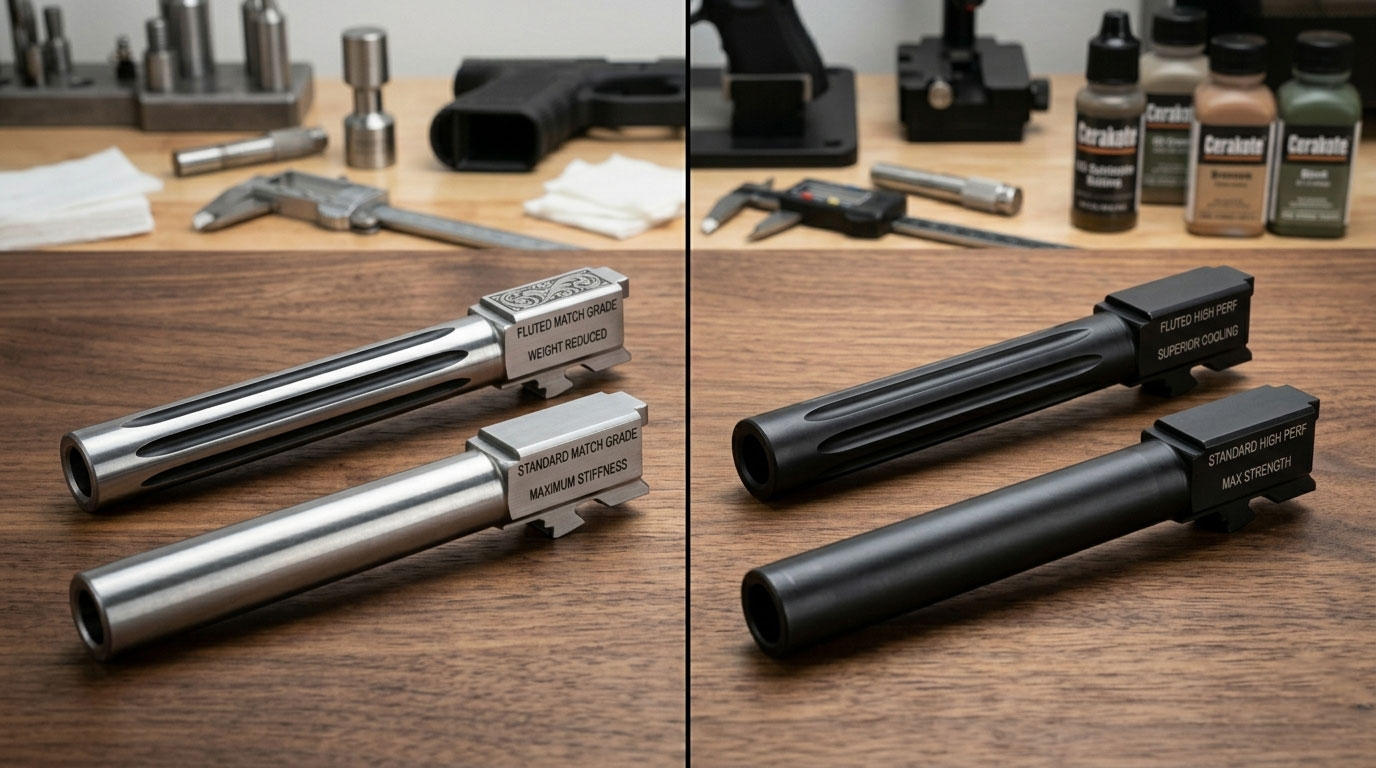
Barrel Fluting vs Standard Barrels: Which One Is Better?
A fluted barrel will save you somewhere between 3 and 8 ounces over a standard contour of the same profile, and that’s the honest reason most shooters get one. Everything else — heat dissipation, rigidity, “the look” — is secondary. Whether the trade is worth it depends on what the rifle is for.
What a standard barrel actually is
A standard barrel is a cylindrical or contoured tube with no material removed from the outside diameter. It’s the default profile out of every barrel maker — Bartlein, Krieger, Proof, Benchmark, Hawk Hill — and it’s what factory rifles ship with. More material means more thermal mass, which means the bore takes longer to heat up under repeated fire and stays straighter as it does. For string-shooting at the bench, a standard heavy contour like an MTU or M24 is hard to beat.
What fluting is and what it does
Barrel fluting is a series of grooves cut along the outside of the barrel, usually straight, sometimes spiral or diamond pattern. The cuts are typically 0.040" to 0.080" deep depending on contour. The grooves remove a measurable amount of steel — call it 4 to 8 ounces on a 24" sporter or magnum-contour barrel — without changing the barrel’s stiffness much, because stiffness is governed by the outside diameter at the deepest point of the cut, not the average.
The marketing line about “increased surface area improving heat dissipation” is technically true and practically marginal. You’ll see a small effect under sustained fire — a few seconds faster cooldown — not the night-and-day difference some ad copy implies.
When fluting is worth it
Fluting earns its keep on rifles you carry. A backcountry hunting rifle, a mountain rifle, a sporter you walk eight miles into a stand with — the half-pound of weight savings between fluted and unfluted matters there. It also pairs naturally with carbon-wrapped barrels and lightweight chassis builds where every component is being optimized for grams.
For competition rifles that live on a bipod, an ELR rig, or a heavy-barrel benchrest setup, the standard contour is usually the right call. The weight is a feature, not a bug — it dampens recoil, settles the rifle on the bag, and runs cooler through a long string.
What fluting won’t do
Fluting will not improve accuracy. A well-made fluted barrel is as accurate as a well-made standard barrel from the same maker, no more. If a barrel is the limiting factor on your group sizes, the answer is a better blank, not flutes on the one you have.
Cost and lead time
Adding flutes to an existing barrel runs roughly $150–$300 depending on the smith and pattern. Buying a barrel pre-fluted from the maker is usually cheaper than retrofitting and gives a cleaner result. Either way it adds machining time, so plan your build calendar around it.
Make the call
Pick a fluted barrel if you’re building a rifle to carry. Pick a standard contour if you’re building a rifle to shoot from a rest. Neither choice will make a bad shooter accurate or a good shooter better — but the right contour for the job makes the rifle feel like it belongs in your hands.
If you’re building or rebarreling and aren’t sure which contour fits your application, talk it through with your gunsmith before you commit to a blank — once the flutes are cut, they’re permanent.
Related services
- Receiver blueprinting to true the action so the new barrel mounts square
- Muzzle threading if you plan to run a brake or suppressor
- Cerakote to refinish the barrel after fluting and protect the exposed metal

Information