
Precision Hunting Rifles vs. Tactical Rifles: Key Differences Explained
Jeremy Walberg Jun 25, 2026
Precision Hunting Rifles vs. Tactical Rifles: Key Differences Explained
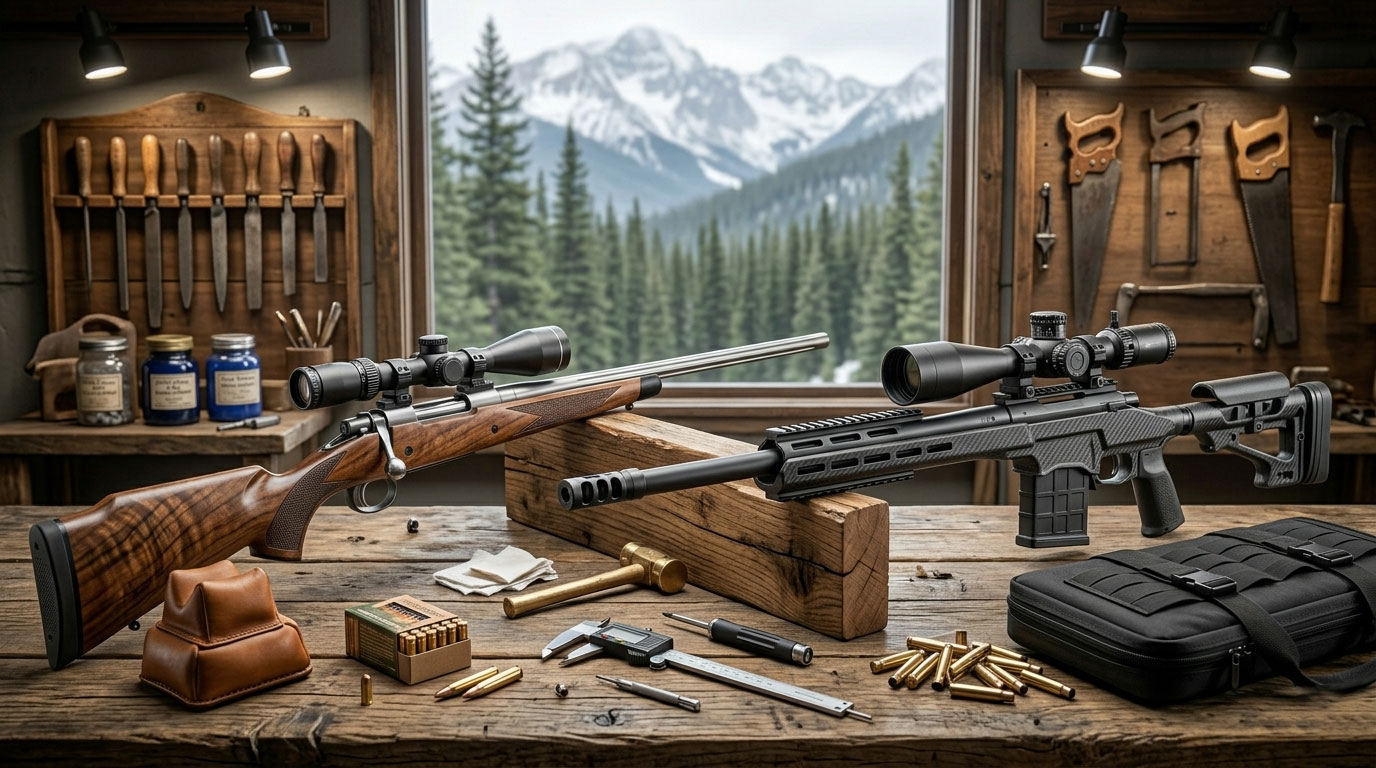
A precision hunting rifle and a tactical or competition precision rifle can both put a bullet on a 10-inch plate at 1,000 yards. They’re built differently because the shooter does different work to get the shot. Hunting rifles are built around carry — weight, balance, weather sealing, cold-bore reliability. Tactical and competition rifles are built around stability and adjustability for repeatable hits over long strings. The same precision machining underpins both, but the spec choices diverge in almost every component.
Weight and how that shapes the rifle
A backcountry hunting rifle is typically 7–9 lbs scoped and ready to shoot. A tactical or PRS-style precision rifle is typically 14–22+ lbs scoped. That difference is intentional and shapes everything downstream:
- Barrel contour — hunting rifles use lighter contours (Sendero Light, #4/MTU light, fluted heavy if you want a middle ground); tactical rifles use heavier contours (M24, MTU, Heavy Palma) for less heat distortion under sustained fire
- Stock or chassis — hunting rifles use lightweight stocks (Manners EH-1, McMillan Game Scout, fiberglass with minimal hardware); tactical rifles use full chassis with side rails, ARCA dovetails, adjustable LOP, and accessory bridges (MDT ACC, MPA BA, KRG Whiskey-3, Cadex)
- Optic mass — hunting rifles get lighter scopes (3-15x or 4-16x typical); tactical rifles run heavier high-mag glass (5-25x, 7-35x)
The hunter’s enemy is fatigue from carrying and a slow first shot. The competitor’s enemy is recoil disturbance and the shooter’s own hold variation across multiple shots.
Optics differ by what’s being shot
Hunting optics prioritize:
- Lower magnification (3-15x, 4-16x range) — most field shots are inside 600 yards
- Lighter weight
- Wider field of view at low mag for snap shots
- Robust internals (handles drops, scope-clad backpack carry)
- Examples: Leupold VX-5HD, Nightforce SHV, Swarovski Z5/Z8
Tactical/competition optics prioritize:
- High magnification (5-25x, 7-35x)
- Christmas-tree reticles for holdover at known distances
- Generous elevation travel (60+ MOA)
- Repeatable, audible turret clicks
- Examples: Nightforce ATACR, Vortex Razor HD Gen II/III, Schmidt & Bender PM II
The mount also differs — hunting uses lightweight rings; tactical uses one-piece mounts on a 20-MOA rail.
Cold-bore vs. hot-string accuracy
Hunting optimizes the cold-bore shot. Most hunting kills are first-shot kills. Reliability of the first round, predicted point of impact in cold barrel conditions, and a stock or chassis that the rifle can be carried in and brought to bear fast — these are what matter.
Tactical/PRS optimizes hot-string consistency. A PRS stage might have you shoot 8–12 rounds in 90 seconds across multiple positions. The rifle has to deliver round 8 to the same point of impact as round 1, after the barrel has heated up and the chassis has loaded against barricades. This is why tactical rifles run heavier barrels, heavier overall mass, and sometimes fluid-filled or tunable barrel-tuner systems.
Calibers and ammunition
Hunting rifles in precision spec commonly run:
- 6.5 Creedmoor, 6.5 PRC — versatile, low-recoil, deer to elk
- .308 Winchester — traditional, broad ammo availability
- .300 Winchester Magnum, .300 PRC, .300 RUM — for elk-sized game and longer shots
- .270 Winchester, 7mm Remington Magnum — open-country hunting
Tactical/competition rifles commonly run:
- 6mm and 6.5 Creedmoor — flat-shooting, low-recoil, dominant in PRS
- 6mm Dasher, 6 BR, 6 GT — competitive precision wildcats
- .308 Winchester — traditional tactical baseline
- .338 Lapua and similar — for ELR and military precision use
The hunter cares about terminal performance — bullet expansion, weight retention, kill performance on game. The competitor cares about flat trajectory, low recoil for spotting impacts, and high ballistic coefficient for wind performance. Bullet selection diverges sharply between the two.
Triggers and ergonomics
A hunting trigger needs to be safe, reliable, and have enough resistance that it doesn’t fire when you slip the safety in cold weather with gloves on — typically 2.5–3.5 lbs. A tactical/competition trigger optimizes for clean break and minimum surprise — typically 1.5–2.5 lbs, sometimes lighter for benchrest.
Stocks/chassis ergonomics also diverge. Hunting stocks have shorter LOP for shooting in cold-weather layers, fixed comb, and minimal hardware that can snag on brush. Tactical chassis have everything adjustable (LOP, comb, butt hook, cheek piece) and accept a barricade stop, ARCA rail, and rear bag rider.
Custom machining for both
The same underlying precision work supports both rifle types:
- Receiver blueprinting — improves cold-bore accuracy on a hunting rifle as much as it improves match consistency on a competition rifle
- Custom barrel chambering with a quality blank and proper headspace
- Muzzle threading — increasingly standard on hunting rifles for suppressor use, which protects hearing and reduces recoil on the cold shot
The differences live in spec choices — which barrel maker, which contour, which trigger, which chassis — not in whether the underlying work is precision-grade. Both deserve precision-grade work.
Choosing the right rifle for you
Pick a precision hunting rifle if:
- You hunt open-country or mountain terrain where you carry the rifle for hours
- The first shot at extended range is the shot that matters
- The rifle has to live in weather: rain, snow, sub-zero temperatures
- Weight on your back during the day-of-the-hunt is a real factor
Pick a tactical or precision competition rifle if:
- You shoot from a stable position (bipod, bag, barricade, prone)
- You’re shooting strings of multiple shots quickly
- You’re running PRS, NRL, or similar matches
- Weight isn’t a meaningful constraint because the rifle stays on the rest
Many serious shooters end up owning one of each. They’re different tools for different problems, and a great example of one isn’t a great example of the other.
Talk through the build before you commit
A precision build that’s wrong for the application is expensive. A 22-pound chassis rifle isn’t a hunting rifle no matter how accurate it is, and a 7-pound mountain rifle isn’t going to win a PRS match. Spec the rifle around how it will actually be used.
Related services
- Receiver blueprinting — foundational for precision in either rifle type
- Custom barrel chambering — match the chamber to the cartridge and bullet weight you’ll shoot
- Muzzle threading — for brake or suppressor mounting
- Cerakote — finish protection for hunting rifles in particular

Information