
Suppressors Explained: Benefits, Myths, and the NFA Process
Jeremy Walberg Jun 25, 2026
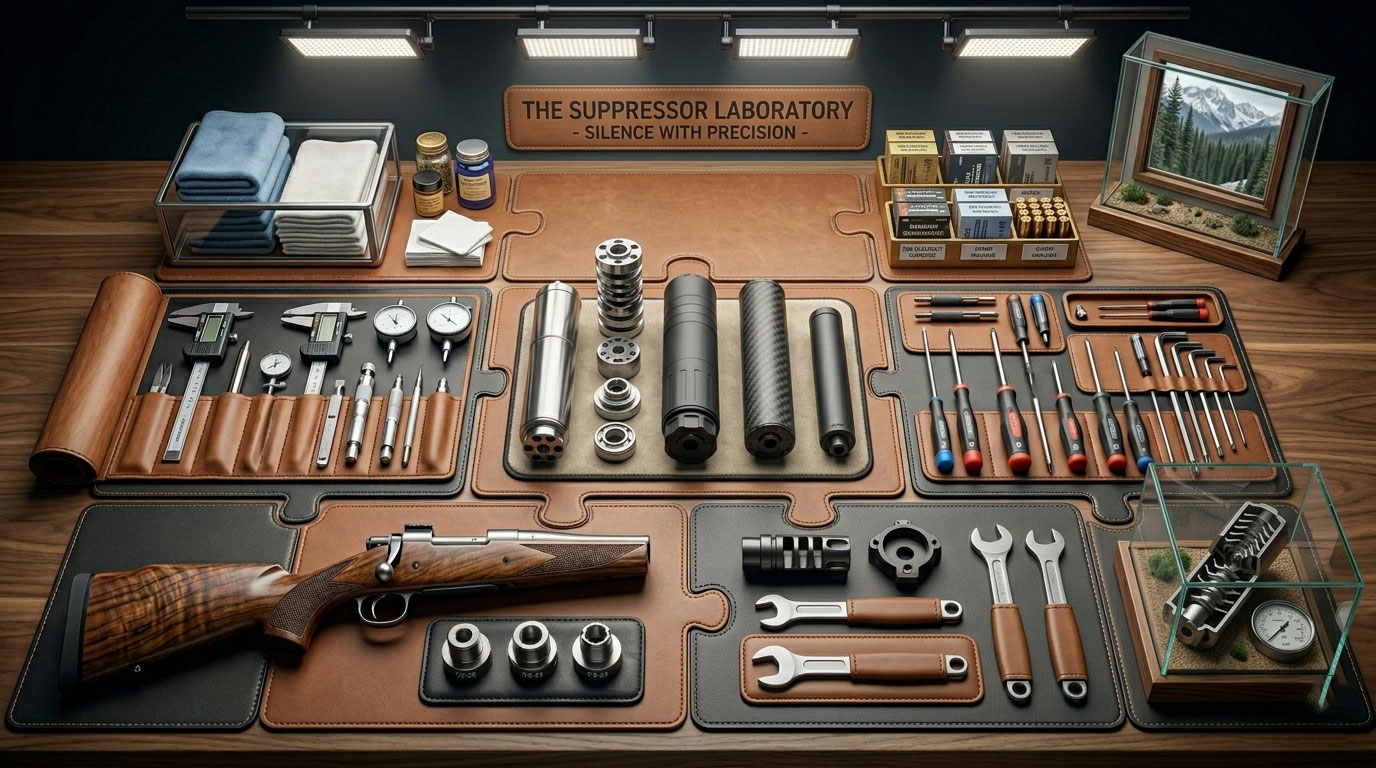
Suppressors Explained: Benefits, Myths, and the NFA Process
A suppressor is a device that screws or clamps onto the muzzle of a firearm and reduces the report — usually by 25 to 35 decibels — by capturing and slowing the muzzle gases through a series of internal baffles. They’re legal to own in 42 U.S. states, but they are National Firearms Act (NFA) items, which means buying one involves the ATF, a $200 transfer tax, and a multi-month wait. Before you commit to a suppressor build, understand both how they work and how you’ll legally take possession of one.
How suppressors actually work
A bullet exits the barrel at high pressure. Without a suppressor, that pressurized gas slams into atmospheric air and creates a sharp acoustic event — the muzzle blast. A suppressor gives the gas somewhere to expand and cool before it reaches the atmosphere. Internal baffles slow, redirect, and thermally exchange the gas, reducing peak pressure at the muzzle and dropping the sound level meaningfully.
Typical noise reduction:
- Unsuppressed .308: ~165 dB (instantaneous, at the shooter’s ear)
- Suppressed .308 with a quality can: 130–135 dB
- Unsuppressed 5.56: ~165 dB
- Suppressed 5.56: 130–140 dB depending on the suppressor
For reference, OSHA’s permissible exposure limit is 85 dB averaged over 8 hours; firearms are damaging without hearing protection at any level. Suppressors don’t make firearms silent — they make them tolerable to shoot without doubling up on hearing protection.
Real benefits
Hearing protection. The most underrated benefit. A suppressed rifle is the difference between a usable hunting tool in the field and one that requires you to fumble with electronic muffs while game is moving. For training, range work, and any environment where situational awareness matters, suppressors are a meaningful safety upgrade.
Recoil reduction. A suppressor adds 8 to 24 ounces of mass at the muzzle and provides a small amount of gas redirection through the baffles. The combined effect typically reduces recoil 10–30% compared to unsuppressed. The shooter can spot impacts through the scope, which is critical for ELR and PRS work.
Reduced concussion to shooters and observers. The blast wave from an unsuppressed rifle is fatiguing during long range sessions, especially with muzzle brakes. Suppressors reduce both the noise and the concussion to the shooter and to anyone standing nearby.
Less hunting disturbance. A suppressed shot doesn’t spook game as broadly. Some hunters report being able to take a follow-up shot at the same group when the first shot was suppressed.
Common myths
“Suppressors make firearms silent.” No. Hollywood and video games are wrong. A suppressed rifle is still loud — closer to a hammer drop or a heavy-duty stapler than to a whisper. The 130 dB number is in the same range as a balloon pop or a chainsaw, just briefer.
“Suppressors reduce velocity / accuracy.” Mostly false. A quality suppressor on a properly threaded barrel typically causes a small point-of-impact shift (you re-zero with the can on) but doesn’t reduce accuracy. Velocity changes are small — sometimes slightly faster (the suppressor adds ~1.5–4" of bore length effectively), sometimes slightly slower depending on backpressure dynamics. Accuracy with a suppressor is often equal to or better than without, because the shooter can hold the rifle more naturally without the noise stress.
“Suppressors are only for special operations.” Suppressors have been NFA-regulated since 1934, but they’re widely owned by hunters, recreational shooters, and competitive precision shooters today. NSSF estimated over 2.5 million civilian-owned suppressors in the US as of recent reports.
“Suppressors need maintenance / servicing.” Sealed cans (most rifle suppressors) are essentially maintenance-free for the life of the suppressor. Pistol suppressors that disassemble for cleaning need periodic baffle cleaning to remove lead and powder buildup. Read the manufacturer’s instructions for your specific suppressor.
The legal process to buy one
This is where most first-time buyers get tripped up. Suppressors are NFA-regulated, which means:
- Find a Form 4 dealer (an FFL with an SOT — Special Occupational Tax — endorsement). The dealer either has the suppressor in stock or orders it.
- You purchase the suppressor. It stays at the dealer.
- Submit ATF Form 4 for the transfer to you. This is filed electronically (eForm 4 is the standard now) by the dealer or you, depending on the dealer’s process.
- Pay the $200 transfer tax. This is per suppressor — every NFA item incurs the tax once on transfer.
- Submit fingerprint cards and a passport-style photo (for individual ownership) or a trust-formation document (for trust ownership).
- Wait for ATF approval. Wait times vary; eForm 4 has been processing in 30–90 days as of recent reporting, paper Form 4 takes longer.
- Pick up the suppressor from your dealer with your approved Form 4.
You cannot take possession of the suppressor until the ATF approves the Form 4. Plan around this — the suppressor sits at the dealer for the duration.
Trust vs. individual ownership
A common decision: own as an individual or via an NFA trust?
- Individual ownership — simpler, single owner, fingerprints and photos required, suppressor passes by inheritance per state law
- Trust ownership — multiple authorized users (trust beneficiaries), simpler estate planning, all trustees over 18 must submit fingerprints and photos to ATF; trust-formation paperwork required
For most first-time buyers, individual ownership is fine. For households where multiple adults will use the suppressor, or for collectors planning for the long term, a trust makes sense. Standard NFA trusts cost $50–$200 to draft from a firearms-savvy attorney or online service.
Where suppressors are legal
Suppressors are legal for civilians to own in 42 US states as of 2026. The 8 states that prohibit civilian suppressor ownership are California, Delaware, Hawaii, Illinois, Massachusetts, New Jersey, New York, and Rhode Island, plus the District of Columbia. (Always confirm against your specific state’s current law.)
For hunting use, individual states regulate whether suppressors can be used while hunting — most allow it now, but check your state’s regulations.
What to spec for a suppressor build
When you commit to a suppressor, plan the rifle around it:
- Barrel needs proper muzzle threading to the suppressor’s thread spec — usually 5/8-24 for .30 cal or 1/2-28 for 5.56
- Suppressor mount choice — direct thread (simplest, slightly more accurate) or quick-detach via a brake/flash-hider mount (more flexible across rifles)
- Suppressor-height irons if mounting on a pistol or carbine where iron sight co-witness matters
- Hearing protection still required for sustained fire — suppressors reduce, they don’t eliminate
Plan the wait into your build calendar
Because of the Form 4 wait, most shooters file their paperwork early — sometimes even before the rifle is built — so the can is approved and ready when the rifle is. If you’re spec’ing a precision build that includes a suppressor, talk to your gunsmith and your Form 4 dealer in parallel, not sequentially.
A suppressor adds capability to a rifle that’s hard to overstate once you’ve shot one. It’s a serious purchase with serious paperwork, but it’s also one of the most consequential single upgrades available to a serious shooter.
Related services
- Muzzle threading — required for any direct-thread suppressor mount
- Custom rifle barrel chambering — done with suppressor compatibility in mind
- Cerakote — pairs with a refinished barrel and suppressor mount surfaces

Information