
Titanium Suppressors: Why Lightweight Matters for Performance
Jeremy Walberg Jun 25, 2026
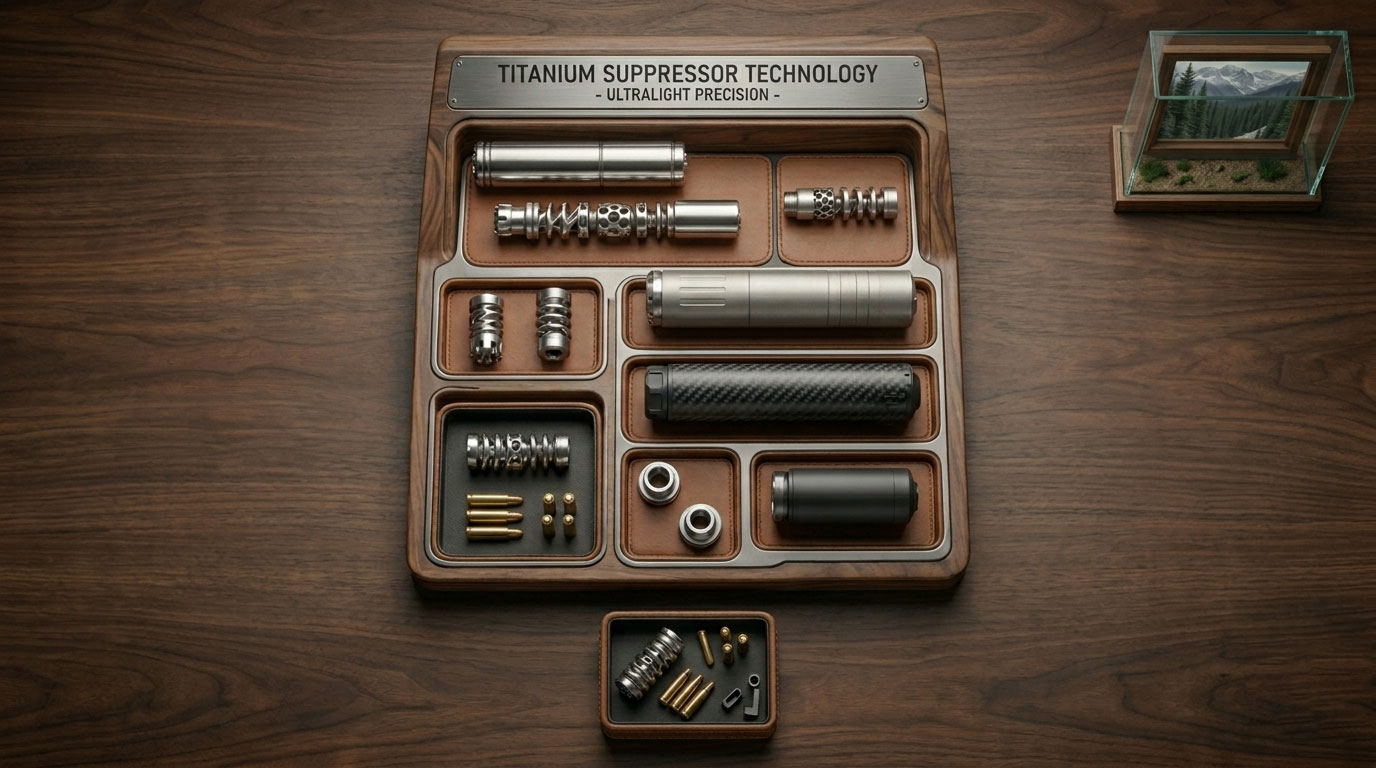
Titanium Suppressors: Why Lightweight Matters for Performance
A titanium suppressor weighs roughly half what an equivalent steel-bodied suppressor weighs. For a hunting rifle you carry into the backcountry or a precision rifle where balance at the muzzle matters, that weight difference changes how the rifle handles. Titanium isn’t the right material for every application — for high-volume full-auto or sustained rapid fire, Inconel is the standard — but for most hunting and precision rifle use, titanium offers the best balance of weight, durability, and longevity.
What titanium offers
Titanium has a strength-to-weight ratio that’s hard to beat: roughly the tensile strength of mid-grade steel at about 56% of the density. For a suppressor, that means tube and end-cap construction can be substantially lighter without giving up the strength to handle the gas pressure cycle.
Typical weight comparisons for a 7.62 / .308-caliber rifle suppressor:
- Steel-bodied: 16–24 oz (1.0–1.5 lb)
- Inconel/stellite-bodied (full-auto rated): 18–28 oz (1.1–1.75 lb)
- Titanium-bodied: 8–14 oz (0.5–0.9 lb)
For a 6.5 mm or 6 mm precision rifle suppressor, the spread is similar. The half-pound to full-pound difference at the muzzle is a meaningful change in rifle balance — a hunting rifle stays mountable; a precision rifle stays settled in the bag.
Where titanium shines
Hunting rifles — backcountry, mountain, and walk-and-stalk hunters benefit from every ounce off the muzzle. A titanium can on a 7-pound hunting rifle keeps the rifle mountable and quick-handling. A heavy steel can pulls the muzzle down and slows the swing.
Precision rifles for bolt-action use — PRS competitors who don’t run sustained strings, ELR shooters, and bench-rest-style work. Titanium handles the heat cycle of a typical 30-round string without issue, and the weight savings improve recoil management and feel.
Suppressed rifles where balance matters — a chassis precision rifle is already heavy; adding 24 ounces at the muzzle changes how it tracks. Titanium reduces that change substantially.
Where titanium doesn’t fit
Full-auto and sustained rapid fire. Titanium has a lower melting point and lower thermal mass than Inconel or stellite. Under sustained full-auto, a titanium baffle or tube can warp or fail. For SBRs running mag dumps, light machine gun work, or any high-cyclic-rate use, Inconel-bodied cans (like the SilencerCo Hybrid Inconel, OSS/HUXWRX BANISH 30 Pro, or the Surefire SOCOM series) are the right call.
Tube construction in all cans. Some “titanium” suppressors use titanium tubes with steel or stellite baffles for the high-heat areas. That’s a sensible hybrid — the body gets the weight savings, the baffles get the heat tolerance. Read the manufacturer spec carefully.
Pistol suppressors. Most pistol cans are aluminum-bodied with stainless or titanium baffles, because the lower velocities and lower pressures don’t justify titanium tubes. There are exceptions — some premium pistol cans are titanium throughout — but it’s not the dominant pattern.
Common titanium suppressors on the market
A few well-regarded titanium-heavy options as of 2026:
- Thunder Beast Arms (TBAC) Ultra series and Magnus — titanium tubes and end caps; long-running standard for precision rifle suppressors
- Q LLC — Trash Panda, Half Nelson, and others use heavy titanium construction
- OSS/HUXWRX FLOW series (titanium variants) — flow-through technology in titanium for hunting and precision use
- Dead Air Sandman-Ti — hybrid construction with titanium tube
- YHM (Yankee Hill Machine) Resonator series — value-priced titanium options
Pricing ranges from $700 (entry titanium) to $1,500+ (premium TBAC or Q). Wait time on Form 4 is the larger gating factor than the can’s price for most buyers.
What durability looks like
A titanium suppressor in normal hunting and precision use should outlast the rifle it’s on. The failure modes:
- Carbon and lead buildup — minor; mostly a non-issue on rifle suppressors that don’t disassemble
- Erosion at the blast baffle — the first baffle takes the most heat and pressure; in titanium, this baffle is sometimes upgraded to stellite or Inconel
- Surface oxidation — titanium discolors and develops a heat-blue patina over time; cosmetic, not structural
For hunting and precision rifle use, expect 5,000+ rounds without meaningful performance degradation. For SBR and tactical use with hotter strings, the lifespan can be shorter and the failure modes can include baffle warping at the blast end.
Threading and mounting
Titanium suppressors mount the same way as any other rifle suppressor:
- Direct thread — simplest, cheapest, slightly more concentric. Common threads: 5/8-24 (most .30 cal), 1/2-28 (most 5.56), 9/16-24 (.338)
- Quick-detach via a muzzle brake or flash hider mount — more flexible across rifles, slightly more weight, slightly more potential for variability
A properly threaded muzzle (concentric to the bore within 0.001“–0.002”) is essential. A poorly threaded barrel can cause a baffle strike that destroys the suppressor — the lighter titanium construction is no more forgiving of bad threading than steel.
Match the suppressor to the rifle
If you’re spec’ing a hunting rifle build with a suppressor, pick a titanium can sized to the cartridge. A .30-cal-rated can on a 6.5 Creedmoor works, but a 6.5-rated can is shorter, lighter, and quieter on that specific cartridge. Multi-caliber capability is a nice-to-have; specific-caliber optimization is what wins for a single-rifle setup.
For precision rifle competition, talk to other shooters running suppressors at your matches. Specific cans become trends in the PRS community as new designs prove out.
Plan the build around the can
Order the suppressor early. Form 4 wait is months. While you’re waiting, the rifle gets built — chambering, threading, action work, finish — and when the can clears, you mount it and zero it. The standard sequence works as long as the muzzle thread spec, brake compatibility (if applicable), and barrel contour are matched to the suppressor from day one.
Related services
- Muzzle threading — the foundation of every direct-thread suppressor install
- Receiver blueprinting — improves the precision baseline that a quality suppressor can deliver to
- Custom barrel chambering — proper headspace and concentricity matter for suppressor accuracy

Information