
How Barrel Chambering Affects Rifle Accuracy and Performance
Jeremy Walberg Jun 25, 2026
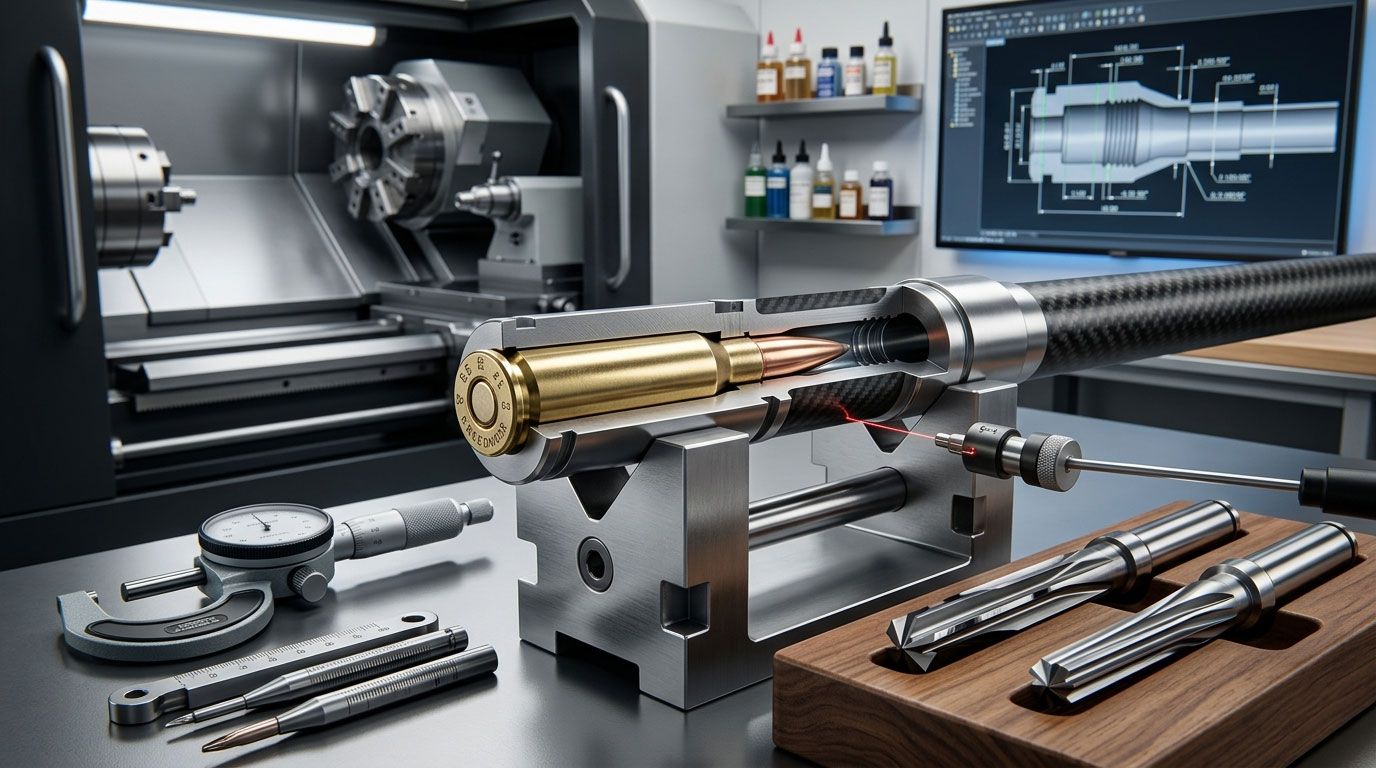
How Barrel Chambering Affects Rifle Accuracy and Performance
Chambering is the process of cutting a precision-shaped cavity at the breech end of a barrel so a specific cartridge fits, headspaces, and fires correctly. Done well, it’s invisible — the rifle just shoots tight groups, feeds and extracts smoothly, and lasts for thousands of rounds. Done poorly, no other component or upgrade can fix what’s broken at the chamber.
What chambering actually involves
A reamer cuts the chamber to the dimensions of the cartridge, plus a small amount of clearance. The work happens with the barrel held in a lathe, dialed in concentric to the bore axis, and the reamer fed in slowly with cutting fluid. The gunsmith sets the chamber depth using go and no-go headspace gauges so the cartridge sits at the correct distance from the bolt face — typically a few thousandths of an inch of crush fit.
The variables a gunsmith controls during chambering:
- Concentricity — the chamber must be cut on the same axis as the bore. A few thousandths of runout shows up as accuracy loss.
- Headspace — the distance from the bolt face to the chamber’s headspacing datum. Too tight and ammunition won’t chamber; too loose and the case can stretch, separate, or print primers.
- Throat dimensions — the leade angle and freebore length affect pressure, accuracy, and how much room there is for the bullet to seat out.
- Chamber tolerance — match chambers (tighter than SAAMI minimum) are standard for precision work; SAAMI or NATO chambers (looser) are standard for factory rifles and semi-autos that need feed/extract reliability across ammunition variation.
Why it matters for accuracy
The cartridge case has to release the bullet from the same starting position, travelling on the same axis as the bore, every shot. A misaligned chamber introduces variation:
- The bullet enters the rifling at a slight angle, which yaws the bullet in flight and opens groups
- Inconsistent neck-to-bore alignment means inconsistent bullet release
- Headspace variation translates directly to velocity variation — the firing pin strike and primer ignition behave differently with a tight or loose case fit
A precision-chambered match barrel will shoot half-MOA or better with quality ammunition. A loose factory chamber on the same blank might only deliver 1.5 MOA — same steel, same rifling, different chamber.
Why it matters for reliability
Chambering also affects how the rifle cycles:
- Feeding — the chamber’s geometry has to let the cartridge transition smoothly from the magazine to fully seated
- Extraction — a chamber that’s too tight, or one with rough finish marks, drags on the case during extraction and can cause case-head separations or stuck cases
- Bolt close — proper headspace means the bolt closes with light, consistent resistance; out-of-spec headspace either binds or feels mushy
For a rifle that’s going to see hard use — a hunting rifle in cold weather, a duty rifle, a semi-auto running varied ammunition — getting the chamber right is what makes the rifle dependable.
Pre-fit barrels vs. gunsmith-fit chambering
Two paths to a chambered barrel:
- Pre-fit barrels for actions like Tikka, Savage small-shank, Bighorn TL3, ARC Nucleus, and similar — the barrel arrives already chambered and headspaced for the action. The shooter screws it on with a barrel nut or wrench, with no machining required. Faster, cheaper, slightly less optimized than a custom-fit chamber.
- Gunsmith-fit chambering for Remington 700-pattern actions and most custom builds — the gunsmith chambers the barrel to that specific action, indicating the bolt face, setting headspace with go/no-go gauges, and squaring everything to the action’s specific dimensions. Slower, more expensive, fully optimized.
For competitive precision work or for any non-pre-fit action, gunsmith-fit chambering is the standard.
The role of the chamber in handloading
If you handload, the chamber determines what’s possible with your loads. A short-throated match chamber lets you seat heavy bullets close to the lands for tight groups. A SAAMI-spec chamber gives you feed reliability with factory ammunition but limits how far out you can seat a bullet. The chamber spec drives load development from day one.
What a good chambering job looks like
When you receive a properly chambered barrel:
- The bolt closes on a sized, headspace-correct round with light, even resistance
- A “go” gauge closes the bolt; a “no-go” gauge does not
- Ammunition extracts cleanly with no drag marks or stuck cases
- Groups deliver to the barrel and ammunition’s potential — half-MOA or better with quality match ammo from a quality blank
If any of those signals are off, the barrel either needs to be re-chambered, re-set, or replaced. There’s no upgrade or accessory that fixes a bad chamber.
Getting it right starts with the gunsmith
Chambering is craft work. The reamer dimensions, the lathe setup, the indication routine, the headspace gauge work — small differences in each step show up downrange as bigger differences in group size. For a precision rifle build, the smith you choose to chamber the barrel matters as much as the barrel maker you buy from.
If you’re spec’ing a build or rebarreling a precision rifle, talk through the chamber spec with your smith before metal gets cut. The specific reamer, throat length, neck diameter, and headspace target should match the cartridge, the bullet weight, and how the rifle will be used.
Related services
- Receiver blueprinting to give the chambered barrel a true action to mate to
- Muzzle threading for brake or suppressor mounting on the same barrel job

Information