
What Goes Into Building a High-Performance Custom Rifle?
Jeremy Walberg Jun 25, 2026
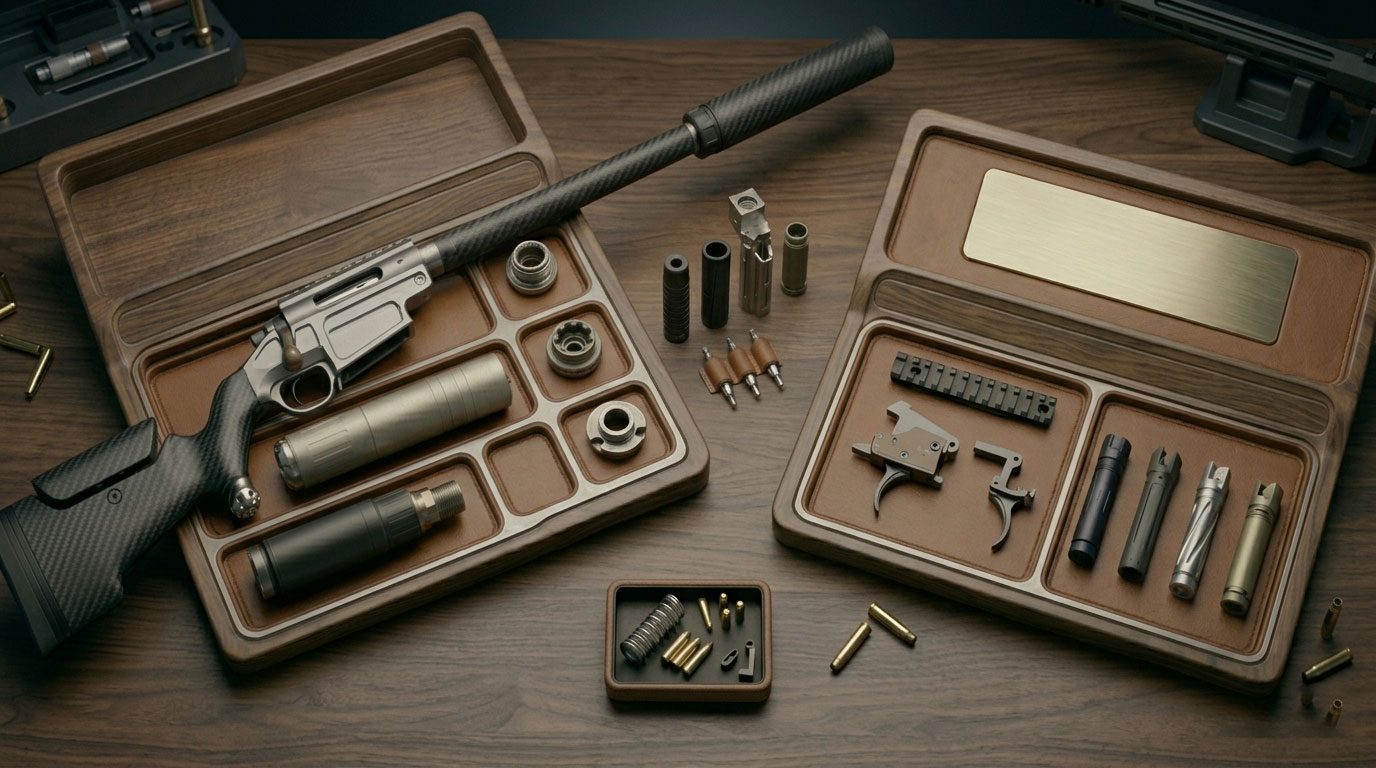
What Goes Into Building a High-Performance Custom Rifle?
A high-performance custom rifle isn't a parts list. It's a stack of decisions - action, barrel, trigger, chassis, optic, ammo - each one matched to the others and held together by precision machining tighter than any factory rifle ships with. The rifle that delivers half-MOA on demand, runs cleanly across temperatures and round counts, and lasts decades comes out of a build process where every link in the chain is deliberate.
Start with the action - the foundation everything fits to
The action determines the build's ceiling. A factory Remington 700 can be blueprinted into a precision platform, but a custom action ships with the same precision baseline from the start.
Common high-performance action choices:
- Custom 700-pattern actions - Defiance Deviant, Bighorn TL3, ARC Nucleus, Impact 737, Surgeon, Zermatt - purpose-built for precision rifle work
- Tikka T3x - excellent factory tolerances, lots of pre-fit barrel options, clean chassis ecosystem
- Blueprinted Remington 700 - the legacy path; with proper trueing, performs at custom-action standards
The action choice drives barrel-fitting method (gunsmith-fit vs. pre-fit), aftermarket support, and which chassis options open up.
The barrel does the actual shooting
Barrel maker matters more than nearly any other single decision. A premium blank from Bartlein, Krieger, Proof, Hawk Hill, Benchmark, or Brux is the difference between a rifle that holds 0.5 MOA and one that holds 1 MOA on the same ammunition.
What you specify:
- Cartridge - match the build's purpose (6mm or 6.5 Creedmoor for competition; 6.5 PRC or .300 PRC for hunting and longer range; 6.5 Grendel or .308 for entry precision; .338 Lapua and up for ELR)
- Twist rate - match the bullet weight you'll shoot
- Length - 22"-26" is the typical range for precision rifles; longer barrels gain velocity but lose handling
- Contour - heavier for stability under recoil and string shooting; lighter for hunting and carry
The chambering - fitting the barrel to your specific action with correct headspace - is where machining quality becomes visible. A precision-chambered match barrel will deliver to its potential. A loosely chambered barrel won't, regardless of the blank.
Receiver blueprinting (for factory actions)
If you're starting from a factory Remington 700 footprint, blueprinting the action is non-optional for a high-performance build. The work - truing the receiver face square to the bore axis, recutting the receiver threads concentric, truing the bolt face, lapping the lug abutments - eliminates the stacked tolerances that limit factory action precision.
A blueprinted 700 mates squarely with the new barrel and delivers consistent lockup and ignition shot to shot. A custom action skips this step.
Muzzle threading and brake or suppressor
Threading the muzzle for a brake or suppressor is standard on a precision build:
- Brake for recoil management on heavy-recoiling cartridges (.300 PRC, .338 Lapua, .375 CheyTac)
- Suppressor for noise reduction, recoil reduction, and the ability to spot impacts through the scope
- Flash hider for low-light shooting
The threading is single-point cut on a lathe with the barrel indicated to the bore axis. Concentricity within 0.001"-0.002" is the standard. Anything looser causes baffle strikes (suppressor) or asymmetric recoil (brake).
Trigger
A clean trigger removes the largest source of shooter-induced error. Common precision rifle triggers:
- TriggerTech - frictionless release, popular in PRS, $200-$400
- Timney - long-running standard, $-$250
- Bix'n Andy - premium, $400+
Set to 1.5-2.5 lbs for precision work. Lighter triggers require deliberate technique; heavier triggers leave more room for movement during the break.
Chassis or stock
The chassis (or stock) holds the action, barrel, and optic in consistent relative position. For chassis-stocked precision rifles:
- MDT ACC, ESS, XRS - popular PRS chassis with extensive accessory support
- MPA BA series - competition-oriented chassis with tunable balance
- KRG Whiskey-3, X-Ray - clean, well-thought-out designs
- Cadex - premium chassis options, common in ELR builds
- AICS / AT - Accuracy International's traditional design
For stock-bedded precision rifles (often hunting builds):
- Manners EH, T2A, T3, T6 - fiberglass stocks
- McMillan Game Scout, A3, A5 - fiberglass stocks
- Foundation Stocks - premium fiberglass with broad action support
The receiver is bedded into the stock or torqued into the chassis to manufacturer spec. Bolts torqued correctly, recoil lug seated square, action level - these are the small things that determine whether the rifle shoots to the barrel's potential.
Bolt optimization
If the build includes a Remington 700-pattern action, the bolt itself can be optimized:
- Bolt face truing - done as part of receiver blueprinting
- Bolt body truing - clearance to the receiver raceway
- Bolt fluting - minor weight savings, debris channeling, aesthetic match
For custom actions, the bolt arrives optimized.
Optic and mount
A precision rifle without a precision scope is a rifle. Plan to spend roughly the rifle's price on the optic. Mount it on a 20- or 30-MOA tapered rail with steel rings, level the reticle, set eye relief, and torque to spec.
For competition and ELR work, second-focal-plane scopes are uncommon - first-focal-plane reticles let you hold over at any magnification, which is essential when ranging or holding for wind.
Custom finishing
Cerakote finishes the rifle - protects the metal from corrosion and wear, allows custom color matching across components, and survives the abuse a precision rifle sees. Apply after all machining is complete; engraving (if any) goes on top of the Cerakote.
Optional finishing touches:
- Engraved logo or owner mark - common on heirloom and presentation rifles
- Two-tone Cerakote - slide one color, frame another; barrel one color, action another
- Cerakote in event/sponsor colors - for raffle and promotional builds
What integration actually costs
A high-performance custom precision rifle, ready to shoot:
- Action: $1,200-$2,500 (custom) or $400-$800 (factory + blueprint cost)
- Barrel and chambering: $700-$1,400
- Trigger: $-$400
- Chassis or stock: $700-$2,500
- Optic and rings: $1,500-$5,000+
- Brake or suppressor: $300-$2,000+
- Cerakote: $200-$500
- Gunsmith labor: $400-$1,000
Total for a serious build: $5,000-$15,000+ depending on component choices.
What separates a high-performance build from an expensive one
The expensive build has the right-sounding components but isn't fitted properly. A 0.003" off-axis chamber on a $1,200 Bartlein blank shoots like a $300 factory barrel.
The high-performance build has thoughtfully chosen components fitted with precision machining at every interface. The result delivers consistent half-MOA accuracy at the limits of the ammunition and the shooter, lasts thousands of rounds, and feels like a coherent system rather than a parts list.
Talk to your builder before you spec
Most successful custom rifle owners didn't pick every component themselves. They chose a builder, described how the rifle would be used, and let the builder steer the spec toward components that work well together. The result is a rifle the smith built for that customer's purpose - not a rifle assembled from a wishlist.
If you're starting a high-performance build, that conversation is the first step. Action, barrel, chassis, optic - pick them in concert, not in isolation.
Related services
- Receiver blueprinting - foundational for factory actions
- Custom barrel chambering - the precision work the rifle is built around
- Muzzle threading - for brake or suppressor mounting
- Cerakote - the finishing layer that protects the rest of the work

Information